
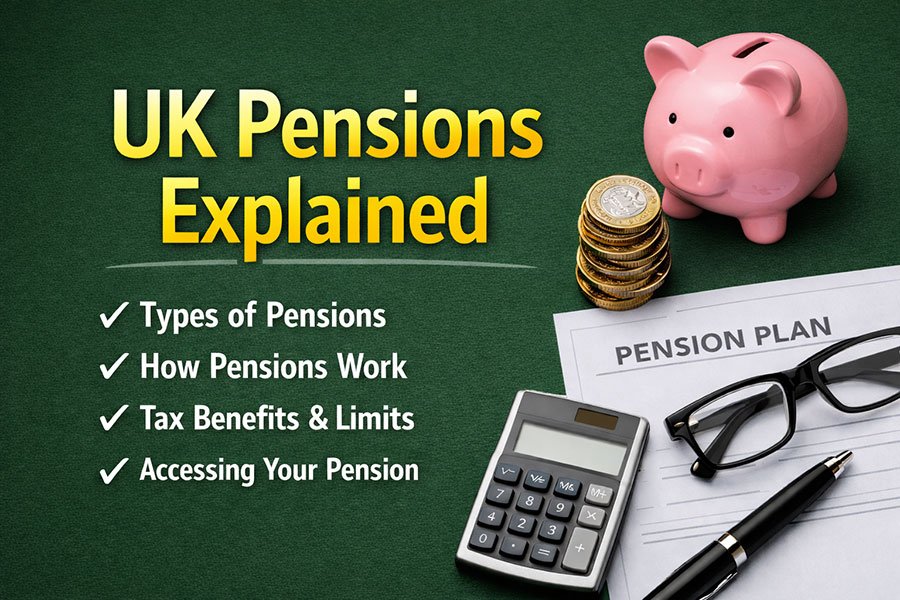

Pensions can feel confusing, especially if no one ever explained to you how they work. This guide explains UK pensions in simple terms, so you can understand the basics.
We’ll be covering the different types of pensions, how they work, the tax benefits, your options when taking money out, and what happens to your pension when you die.
What Is a Pension?
A pension is a form of saving or income source that you use in later life or retirement. You put money aside during your working years so that you can support your lifestyle when you stop working.
In the UK, there are different types of pensions. In this blog I’ll cover workplace pensions, personal pensions, and the State Pension.
What Is a Workplace Pension?
A workplace pension is arranged for you by your employer. Where you work will mean your workplace pension might look slightly different. However, there are generally two main subcategories, these are Defined Contribution pensions and Defined Benefit pensions.
What Is a Defined Contribution Pension?
Defined contribution pensions are the most common type of workplace pension today. You and your employer contribute a percentage of your salary, the money is invested, and the value at retirement depends on contributions from you and your employer, investment growth in your pension, and charges applied to your pension.
Auto-enrolment is the system that requires employers to automatically enrol eligible employees into a workplace pension. Under the current rules, a minimum of 8% of qualifying earnings must be paid into the pension, made up of at least 3% from the employer and the remaining 5% from the employee, which can include tax relief depending on how the pension scheme is set up. Some employers choose to contribute more than the minimum, so it’s always worth checking your own scheme details with your employer.
What Is a Defined Benefit Pension?
With a defined benefit pension you and your employer both still contribute but instead of a pot of money at retirement, a defined benefit pension provides a guaranteed income for life.
The amount you receive is determined by a formula that considers your salary during your working years and the number of years you’ve been part of the scheme, this formula will vary depending on what defined benefit scheme you’re in and when you joined but typically, the longer you are in a defined benefit scheme and the higher your salary has been while you were in that scheme the larger your pension income will be in retirement.
They are now rare in the private sector but remain the most common pension in public sector roles such as the NHS, teaching and the civil service.
What is the difference between a Defined Benefit Pension and a Defined Contribution Pension?
The key difference here is the pension income of a defined benefit scheme is the responsibility of the employer. The employer has to ensure it pays out its promised benefits and this provides more certainty as you’ll know you will be receiving a specific income in retirement that goes up with inflation for the rest of your life.
Whereas with a Defined Contribution scheme, there are no guarantees, it is up to you to ensure there is enough in your pension pot to fund your lifestyle in retirement.
What Is a Personal Pension?
A personal pension is not linked to an employer but is still a type of defined contribution pension. There are different types of personal pensions such as a SIPP, stakeholder pension, private pension and whilst the features of these pensions slightly differ ultimately they all work in the same way.
What Is the State Pension?
The State Pension is paid by the government once you reach State Pension age. Currently the State Pension age is 66 and scheduled to rise (depending on your date of birth).
Your entitlement to the State Pension is based on your National Insurance (NI) record. In most cases, you need at least 10 qualifying years to receive any State Pension and around 35 qualifying years to receive the full new State Pension.
What are the Tax Benefits on Pensions?
Pensions benefit from income tax relief. Workplace pension contributions are usually taken before income tax is applied. With personal pensions, HMRC adds basic rate tax relief directly to your contribution. If you are a higher or additional rate taxpayer, you can claim this additional tax relief either via a self-assessment tax form or on the HMRC website
How Much Can You Pay Into a Pension?
For the 2025/26 tax year, the annual allowance is £60,000 or 100% of your earnings if lower. This includes both personal and employer contributions.
Some people may have a lower annual allowance due to additional pension rules. The tapered annual allowance affects high earners and can reduce the £60,000 limit if your income exceeds certain thresholds. The Money Purchase Annual Allowance (MPAA) applies if you’ve already taken taxable income from a defined contribution pension, such as through drawdown, and this reduces how much you can contribute to pensions with tax relief going forward.
These rules can significantly limit future pension contributions, so it’s important to understand whether they apply to you.
How Can You Take Money Out of a Pension?
Taking Money from a Defined Benefit Pension
If you have a defined benefit pension, often referred to as a final salary or career-average scheme, it will usually pay you a guaranteed income for life from a set retirement age, commonly around 60 or 65. You can normally choose to take the pension earlier than this, although the income is usually reduced because it is expected to be paid for longer. Equally, you may be able to take it later, which can increase the income you receive. The income paid from a defined benefit pension is taxable, similar to salary, and often increases each year in line with inflation.
With a defined benefit scheme, you also have the option to reduce your income in exchange for a tax free lump sum. Each scheme differs on this and as you approach the normal retirement date, the scheme should write to you letting you know your options.
Taking Money from a Defined Contribution Pension
Unlike defined benefit pensions, defined contribution pensions offer much more flexibility over how and when income is taken. You can currently access these pensions from age 55, although this is due to increase to 57 from April 2028. Rather than providing a guaranteed income, a defined contribution pension builds up a pot of money, and how you take income from it is largely your choice.
What Is Pension Drawdown?
One of the most common ways to take money from a defined contribution pension is through pension drawdown, also known as flexi-access drawdown. With this approach, typically 25% of your pension can be taken tax-free, with the remaining 75% subject to income tax. You do not have to take the tax-free amount all at once; instead, it can be taken gradually alongside taxable income. For example, if you withdraw £2,000, £500 may be tax-free and £1,500 taxable. Pension drawdown allows you to take income flexibly, but because the remaining pension stays invested, the value can go up or down and needs careful planning to ensure it lasts throughout retirement.
What is an Annuity?
An annuity is a more fixed way of taking income from a defined contribution pension. Typically, you take your 25% tax-free lump sum first and then use the remaining pension pot to buy a guaranteed income from an annuity provider. This income can be paid for life or for a set period and may include features such as payments continuing to a spouse after death or increases to help protect against inflation. These additional options usually reduce the starting level of income. Typically income received from an annuity is taxable.
Can You Combine Different Pension Withdrawal Options?
Yes, many people use a combination of approaches. Some choose to use pension drawdown earlier in retirement for flexibility and then move towards more secure income later on, particularly when the State Pension starts. The most suitable approach will depend on your income needs, tax position, other guaranteed income and how comfortable you are with investment risk.
What Happens to Your Pension When You Die?
What happens to your pension when you die depends on the type of pension you have. With a defined benefit pension, benefits do not usually pass on as a lump sum. Instead, the scheme may continue to pay a reduced income to a spouse, civil partner or other dependant, often around 50% of the pension you were receiving, although this varies by scheme. If you have used your pension to buy an annuity, what happens on death depends on the options chosen at the outset, such as whether income continues to a spouse or is guaranteed for a minimum period.
If you have a defined contribution pension, then whatever is left in the pot can be passed on. The pension provider will take into account your wishes of who you want the pension to go, to these people will be known as your beneficiaries, so make sure they’re named on your pension.
If you die before the age of 75, your beneficiaries will normally inherit your pension pot tax-free. If you die after the age of 75, then your beneficiaries will pay income tax on anything they withdraw from your pension savings.
Key Takeaways
- Workplace and Personal Pensions benefit from tax relief which make them an attractive way of saving for the future
- How and when you take pension income depends on the type of pension you have whether it is a defined contribution or a defined benefit scheme
- Whether you can pass your pension on to your beneficiaries also depends on the type of pension you have
How Can We Help With Your Pensions?
If you’d like help understanding your pensions or want to check whether you’re making the most of what you’ve already built up, you can book an initial call to talk things through.
During the call, we can look at how your pensions work, how they fit into your wider plans, and whether there are any simple steps worth considering. There’s no obligation — just a chance to get clarity and make sure your pensions are aligned with your long-term goals.
This content provides is for educational purposes only and does not constitute personal advice. Should you need advice, please request it.