

Pension Drawdown vs Annuity UK: Which Suits You?
If you’re approaching retirement with a defined contribution pension, you might be wondering: how do you actually take an income from it?
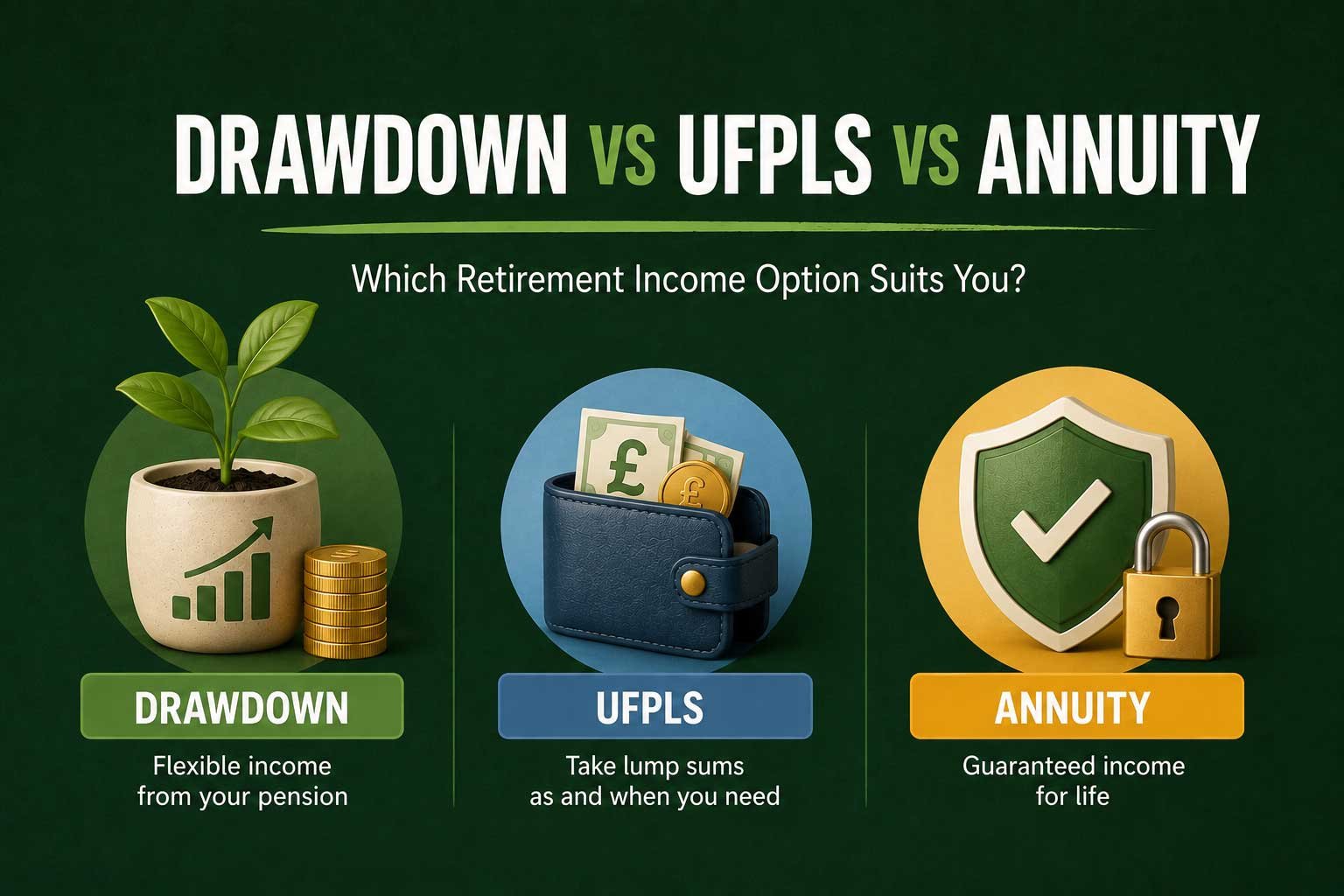
In this post I want to walk you through the three main retirement income options; annuity, drawdown, and UFPLS. I use a real-world example so you can see what they look like in practice.
Meet Tom: a £250k Pension, Three Options
Meet Tom who is 60. He’s already receiving a defined benefit pension that uses up his personal allowance, and on top of that he’s built up a £250,000 pension pot. Retirement is close, and Tom needs to decide how to turn that pot into an income.
Tom isn’t just thinking about himself either. He wants to make sure that if anything happens to him, his wife Jane is looked after too.
Does Tom want the certainty of a guaranteed income? Or does he want the flexibility to take money as and when he needs it? Let’s look at his options.
Option 1: Annuity
An annuity is where you exchange the taxable part of your pension for a guaranteed income for life.
Typically, you take your tax free cash first then use the remainder for an annuity. In Tom’s case, he takes his 25% tax-free cash, that’s £62,500, leaving £187,500 to convert into an annuity.
Based on typical rates for a healthy 60-year-old at the time of writing:
- Standard (level) annuity: around £13,000 a year, roughly 7% of the £187,500. This doesn’t rise with inflation, so its real spending power falls over time.
- Inflation-linked (RPI) annuity: around £8,400 a year, roughly 4.5%. It starts lower, but rises each year in line with inflation, protecting Tom against the rising cost of living.
- Joint-life annuity (50% to Jane, no inflation increases): around £12,300 a year, roughly 6.6%. If Tom dies first, Jane continues to receive half this income.
- Single-life annuity with a 10-year guarantee: around £12,800 a year, roughly 6.8%. If Tom dies within the first 10 years, the income continues to be paid out for the remainder of that period.
Please note, annuity rates move with gilt yields and can shift noticeably from week to week so take these figures as a guide at the time of writing.
Pros of an annuity:
- Guaranteed income for life, with no market risk
- Easy to budget around
- Options to protect a spouse or add a guarantee period
Cons of an annuity:
- Once set up, it generally can’t be changed or undone
- A level annuity loses purchasing power to inflation over time
- Adding inflation protection or spousal benefits reduces your starting income
- Nothing is left to pass on beyond any guarantee period or joint-life arrangement
Option 2: UFPLS Explained
An Uncrystallised Funds Pension Lump Sum (UFPLS), is one of the simplest ways to access a pension. You take a lump sum directly from your uncrystallised pot. There’s no need to move it into drawdown or buy an annuity first.
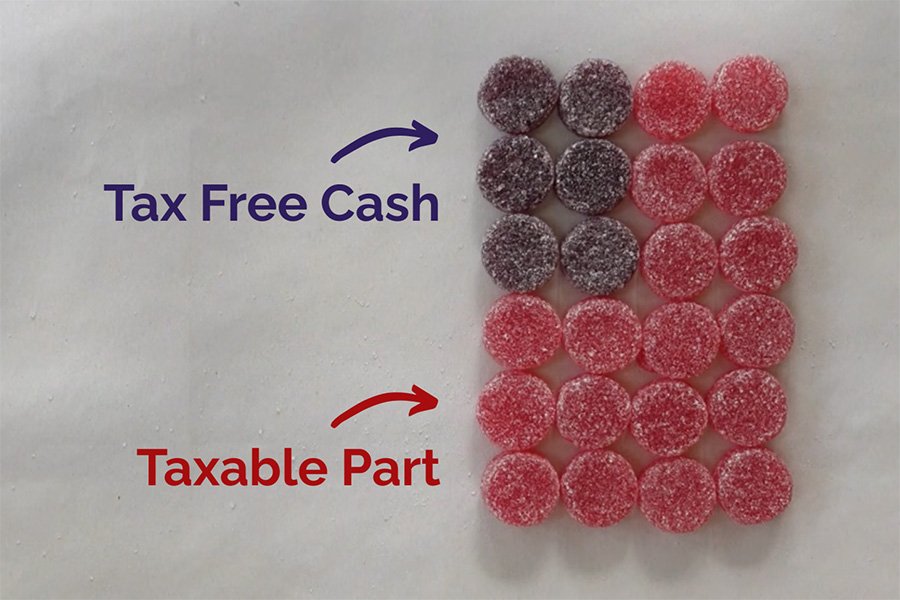
Below we have Tom’s pension represented in sweets, the blue ones standing for the tax-free portion and the red ones for the part that’s taxable.
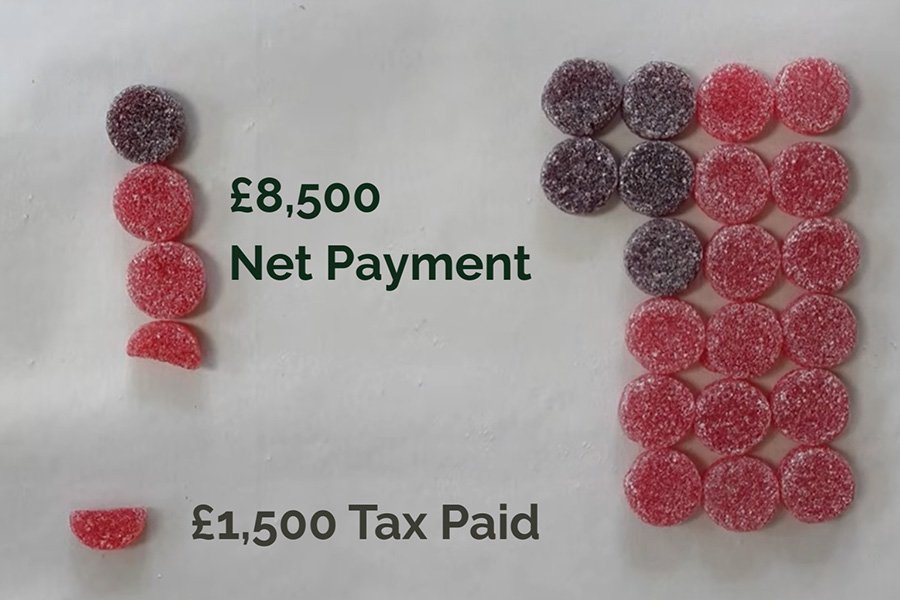
So if Tom takes a £10,000 UFPLS:
- £2,500 (25%) is tax-free
- £7,500 (75%) is taxable. At 20% basic rate, that’s £1,500 in tax
- Net amount received: £8,500
Pros:
- Simple, one-off way to access money without setting up a formal drawdown arrangement
- Useful for occasional lump sums rather than an ongoing income
Cons:
- Every withdrawal is part taxable, so it’s easy to trigger a bigger tax bill than expected if you’re not careful
- Once withdrawn, that money is now in your bank account so no longer invested
- Less flexible than drawdown if you want an ongoing, structured income
- Taking a UFPLS triggers the Money Purchase Annual Allowance (MPAA), cutting how much you can pay into a pension afterwards from £60,000 to £10,000 a year. Worth knowing if you’re still working and contributing to a pension.
UFPLS tends to get overshadowed by drawdown in most retirement conversations, but for ad-hoc lump sums it’s often simpler to set up and administer.
Option 3: Drawdown (Flexi-Access Drawdown)
Drawdown is generally the most popular option as it gives you the greatest level of control.
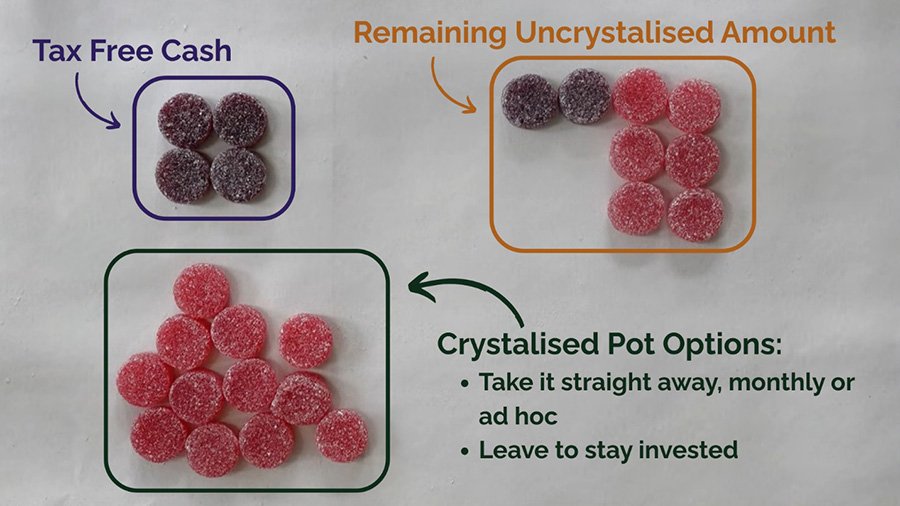
To use drawdown, you first need to crystallise part of your pension, essentially telling your provider “I’m ready to start taking money from this.” Crystallising moves your pot from the saving stage to the spending stage.
When you crystallise an amount, 25% becomes tax-free cash paid out to you and the remaining 75% moves into a “crystallised” part of your pension, which stays invested and can be drawn from flexibly when you want.
You don’t have to crystallise your whole pension in one go. You can crystallise just enough to meet your needs.
For example, say Tom wants to take £10,000 of tax-free cash. He would crystallise £40,000 of his pension pot: £10,000 becomes his tax-free cash, and the remaining £30,000 stays invested in his crystallised pot.
From there, Tom has a few choices for that £30,000: withdraw it all in one go alongside his tax-free cash, draw it down monthly, take it out as ad-hoc lump sums, or simply leave it invested to keep growing.
What if you want a monthly income? Well, let’s say Tom wants a net monthly income of £1,700. He has two ways to get there:
- Both tax-free cash and taxable elements: Crystallise £2,000 a month of which £500 is tax-free cash and £1,500 from the taxable portion (this is taxed at 20%, so £300 tax taken off on withdrawal), giving him £1,700 net. This is similar to the UFPLS method.
- Tax-free cash only approach: crystallise £6,800 a month, taking the full £1,700 as tax-free cash, with the remaining £5,100 staying invested in his crystallised pot for later.
Pros:
- Ability to take just your tax-free cash on its own, without taking any taxable income at all (which UFPLS can’t do since every UFPLS withdrawal automatically includes a taxable slice), this also means you can avoid triggering the Money Purchase Annual Allowance if you only take tax-free cash
- Ability to spread taxable withdrawals to manage your tax bracket, particularly useful once your State Pension
- Remaining funds stay invested and can continue growing
- Anything left over can be passed on to Jane or the children
- You can still buy an annuity later if your circumstances change
Cons:
- No guarantees. Investment performance and how much you withdraw both affect how long the money lasts
- Requires ongoing management and review to make sure withdrawals are sustainable
A General Comparison (Not Personal Advice)
Every situation is different, and the right option depends on your own circumstances, health, other income and family situation. But as a general starting point, here’s how people often think about these three options:
| Retirement Income Option | Often considered when… | Key trade-off |
| Annuity (level) | You want a guaranteed income for life with no market risk | Income is fixed and won’t rise with inflation, and the decision generally can’t be reversed |
| Annuity (with inflation protection) | You want a guaranteed income for life with no market risk that doesn’t lose purchasing power | Starts noticeably lower than a level annuity |
| Annuity (with joint-life or guarantee period) | You want an annuity but where the spouse or dependant to keep receiving some income if you die, rather than the income stopping entirely | Reduces your own starting income to fund that protection |
| UFPLS | You want to access money as one-off lump sums rather than a regular income, and you’re comfortable that each withdrawal comes out in a fixed 25/75 tax-free-to-taxable proportion | You can’t isolate just the tax-free portion, so every withdrawal creates a tax event and can trigger the MPAA |
| Drawdown | You want the ability to take tax-free cash on its own without triggering taxable income, and have flexibility where you can set up monthly income or take ad-hoc payments | Requires ongoing investment decisions and reviews to ensure your withdrawals are sustainable for your retirement plans |
This table is a general illustration only, not a recommendation. What’s right for you will depend on your full financial picture, so it’s worth getting advice on pension withdrawals specific to your own circumstances before deciding.
Frequently Asked Questions
What is the difference between UFPLS and drawdown?
Both let you access your pension flexibly, and both split what you take out as 25% tax-free and 75% taxable. However with UFPLS, every withdrawal automatically comes out in that fixed proportion, so you can’t take tax-free cash without also taking some taxable income at the same time. With drawdown, you can separate the two: take just the tax-free cash and leave the taxable portion invested until you actually need it, or draw both together if that suits you better.
What happens to my pension if I die while in drawdown?
Money left in a drawdown pot can usually be passed on to your beneficiaries. Whether they pay tax on it typically depends on your age at death.
Will my pension be subject to inheritance tax if I leave money in drawdown?
Not under the current rules, but this is changing. From 6 April 2027, most unused pension funds and drawdown pots will be brought into your estate for inheritance tax purposes, following the Finance Act 2026.
Get Advice Before You Decide
Turning a pension pot into a retirement income is a big financial decision that requires thinking through. If you’re approaching retirement and want to understand which option, or combination of options, suits your situation, I offer a free initial call to talk through your circumstances.