


Pension vs ISA vs Buy-to-Let: Which Is the Best Investment?
Property, pensions, or ISAs: it’s one of the great UK investing debates. It’s right up there with “north vs south” and whether the milk goes in before or after the tea. Everyone’s got a strong opinion, and most people are convinced theirs is the right one.
There isn’t a single correct answer. It depends on your goals, your risk tolerance, and what you actually value: control, flexibility, growth, or simplicity. In this article, I’ll break down the key factors that should shape your decision: growth rates, tax, leverage, accessibility and control. Then I’ll walk through a real worked example that might just shift your thinking on what’s best for you.
Growth
Let’s start with the numbers. Looking at average UK house prices from 1970 to 2024, property has delivered an average annual growth rate of 8.65%. Over the same period, a 100% global equity fund tracking the MSCI All World Index returned a slightly higher 9.87% a year.
It’s worth mentioning up front, using averages can be risky. A pension or ISA invested in a global fund is spreading your money across roughly 1,500 stocks in 23 countries. A buy-to-let is one property, in one location, and location matters enormously. London, for example, has seen roughly twice the property growth of Scotland and North East England over the last 50 years. So treat national property averages with a pinch of salt when looking at past performance.
Tax
Buy-to-let has become considerably more expensive to hold from a tax perspective over the last decade. As of 2026, buying an additional residential property in England means paying the standard Stamp Duty Land Tax bands plus a 5% surcharge on top for a second property or investment purchase.
Once you’re renting it out, profits are taxed at your marginal rate; 20% for basic-rate taxpayers, 40% or more for higher-rate taxpayers and above. Also landlords can no longer deduct mortgage interest from their taxable rental income; relief has been capped at 20% since 2020.
When you eventually sell, Capital Gains Tax applies: 18% for basic-rate taxpayers, 24% for higher-rate taxpayers, after your £3,000 annual exempt amount.
ISAs are simple by comparison. No income tax or Capital Gains Tax on growth, income or withdrawals.
Pensions offer tax relief up front. Contributions receive tax relief at your marginal rate, a 20% boost for basic-rate taxpayers, 40% for higher-rate taxpayers etc. When you come to withdraw your pension, usually 25% can be withdrawn tax-free, with the rest taxed as income at your marginal rate.
Leverage
You might be wondering with all those taxes, why even consider property at all? Well, one key advantage of property investment is leverage.
With a buy-to-let, you typically only need to put down 25% of the property’s value, borrowing the rest through a mortgage. That’s fundamentally different to an ISA or pension, where you can only ever invest what you actually put in.
Say you buy a £150,000 property with a £37,500 deposit. If prices rise 10%, your property is now worth £165,000, a £15,000 gain. But you only put in £37,500 of your own money, so that gain actually represents a 40% return on your capital, before tax and fees.
However it works both ways, if the market falls 10% instead, your property drops to £135,000, and your £37,500 equity is now worth £22,500, a 40% loss. Leverage magnifies gains, but it also magnifies losses, and you’re still on the hook for the mortgage regardless of which way prices move. Any BTL decision needs a realistic buffer for that risk.
Accessibility
Property is the least accessible of the three. Selling can take months, involves legal costs and estate agent fees, and there’s no guarantee of timing. Remortgaging to release cash is an alternative, but it depends on your property’s value and your lender’s criteria, and it means taking on more debt. Rental income can help with cash flow along the way, but it isn’t guaranteed either; tenants miss payments, and properties sit empty between lets.
ISAs are by far the most accessible. You can withdraw whenever you like, with no penalty and no tax. That said, if you’re investing rather than saving through an ISA, it’s still worth keeping the money in for the long term. Markets move up and down in the short run, and staying invested gives you the best chance of riding that out.
Pensions are the least flexible of the three. You can’t normally access a pension until 55 (57 from April 2028). As I mentioned in the Tax section, normally only 25% comes out tax-free, but the rest is taxed as income, so a large one-off withdrawal beyond your tax-free portion needs some thought about the tax implications.
If flexibility matters most to you, an ISA is hard to beat. If you’re investing for the long term and won’t need the money for years, pensions and property both are worth considering.
Control
Property gives you the most hands-on control of the three. You can renovate a kitchen or bathroom to add value, negotiate a discount to secure instant equity, or extend and add planning permission to boost the property’s worth significantly.
With ISAs and pensions invested in funds, you don’t control how the underlying companies or markets perform, but you do control where your money goes, choosing the right mix of equities, bonds and other assets for your needs.
If you like getting stuck in and feel confident adding value yourself, property might suit your skillset. If you’d rather take a hands-off approach and let a diversified portfolio do the work, ISAs and pensions are the more natural fit. It really comes down to how much control and involvement you want.
There’s a personal and ethical dimension here too, worth a brief mention. Some people feel uneasy about owning additional property in a market where home ownership feels increasingly out of reach for many, while others who invest in funds have similar concerns about where that money is ultimately allocated, from an environmental or social perspective. This might influence your own decision
£50,0000 Example
James earns £51,000 a year, just tipped into the higher-rate tax band. He has £50,000 to invest and is deciding between a buy-to-let, an ISA, or his pension, all for at least a 10-year horizon.
A quick caveat: the figures below are based on today’s rules, allowances and tax rates. These will move around over time, so treat this as an illustration of how the mechanics play out, not a forecast.
Buy-to-let: James finds a £155,000 property with a gross rental yield of around 6.7%. Here’s how the costs break down.
Upfront investment (£49,100 total):
- 25% deposit: £38,750
- Stamp Duty Land Tax (including the 5% surcharge): £8,350
- Legal fees: £1,500
- Mortgage arrangement fees: £500
Annual running costs (against rental income of £10,416):
- Interest-only mortgage payment (at a 5% rate): £5,813
- Letting agent fee (10% of rent): £1,042
- Repairs reserve (10% of rent): £1,042
- Remortgage/admin costs: £100
- Allowance for around a week’s void period: roughly £200
- Income tax on the rental profit (higher-rate): £2,781
After all of that, James is left with a negative cash flow of around £578 a year, before any capital growth. Assuming 5% average annual property growth, after 10 years, and after paying off the mortgage, selling costs and Capital Gains Tax, James is left with a return on his original investment of roughly 103%
ISA: James invests the equivalent £49,100 in ISA (he uses both his and his partners allowance and straddles the contributions over 2 tax years) at the same underlying growth rate of 5% as the property example. After accounting for ongoing fund and platform charges, that comes down to a net annual return of 4.55%. With no tax to pay on the way out, after 10 years his ISA return comes to around 56%.
Pension: James pays in £49,100, which, thanks to tax relief, is grossed up to £61,375 in his pension. Growing at the same net rate over 10 years, and after accounting for the 25% tax-free lump sum and income tax on the rest at withdrawal, his return comes to roughly 73%.
At this particular growth rate, property comes out ahead. But the picture shifts with different growth rates as shown below:
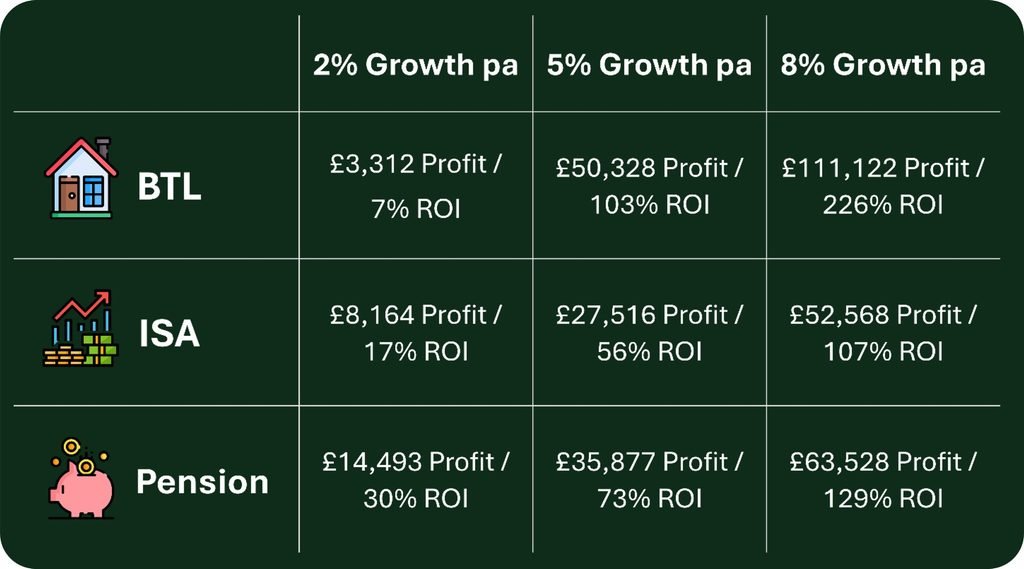
At a lower growth rate, property’s costs and negative cash flow start eating into returns much faster than they do for the ISA or pension, and property’s ROI advantage is reduced. At a higher growth rate, leverage pushes property’s return beyond the other two.
Property’s advantage is highly conditional on both the growth rate you actually achieve and the specific property you buy, which brings me back to that earlier point about how much national averages can be misleading.
What would I do?
If I were in James’s shoes, with around £50,000 to invest today, I’d lean towards ISAs and pensions, even accepting a potentially lower return in the 5% and 8% scenarios above.
Property has been a genuinely strong investment over past decades, helped by rising prices, favourable tax treatment and the power of leverage. But the picture today is different. The stamp duty surcharge, mortgage interest relief capped at 20%, higher interest rates, and the risk of an unexpected repair bill or a long void period can make the margins uncomfortably thin, particularly if you’re running a negative cash flow year-on-year, as James is, and relying on capital growth alone to make up the difference.
There’s also concentration risk to weigh up: a single property’s return depends heavily on where you buy, in a way that a globally diversified equity fund spread across hundreds of companies and countries simply doesn’t.
None of that means property doesn’t have a place. It can work well if you enjoy being hands-on, are good at spotting a deal, or are comfortable using leverage to scale up. But for many people, and for me, at this point, a more passive, tax-efficient and flexible approach through ISAs and pensions is preferred.
What really matters is that whichever route you choose, it stacks up against today’s rules and today’s market, not the version of property investing we remember from 20 years ago. The rules keep changing, and your strategy should reflect where things actually stand now, not where they used to be.
This is a genuinely personal decision, and there’s no universally “right” answer. It depends on your goals, your appetite for risk, and how hands-on you want to be. If you’d like to talk through what makes sense for your own circumstances, I’m happy to help.
Talk to me about your investment options →
Frequently asked questions
Is a pension better than a buy-to-let property?
It depends on your goals. Pensions tend to offer stronger tax efficiency, especially for higher-rate taxpayers, and require far less hands-on effort, for more information see our Pensions Explained Blog. Buy-to-let can outperform when property values grow strongly and you’re comfortable with the leverage, the ongoing costs, and being a landlord. Neither is “better” in every scenario.
Can I invest in both an ISA and a pension at the same time?
Yes. Most people use both: a pension for long-term, tax-relieved retirement saving, and an ISA for more flexible, accessible investing alongside it. They’re not mutually exclusive, and using both is often the most sensible approach.
What tax do you pay on a buy-to-let property in the UK?
As a landlord you’re likely to face three types of tax: Stamp Duty Land Tax when you buy (including a 5% surcharge on additional properties), Income Tax on your rental profit at your marginal rate, and Capital Gains Tax when you sell (18% or 24% depending on your tax band, after your annual exempt amount).
Is it better to invest a lump sum in an ISA or a pension?
It usually comes down to when you need access to the money and your current tax rate. Pensions can offer more valuable tax relief upfront, particularly for higher-rate taxpayers, but lock your money away until at least 55 (57 from 2028). ISAs offer no upfront relief but complete flexibility and tax-free access at any time.
Does leverage make buy-to-let a better investment than a pension or ISA?
Leverage can significantly boost your returns on capital if property prices rise, because you’re only putting down a fraction of the purchase price. But it works both ways: it magnifies losses in a falling market just as much as it magnifies gains in a rising one, and you’re still liable for the mortgage regardless.
A note on the figures: this article uses UK tax rates, thresholds and allowances as they stand in 2026. These change regularly, so please check current rates before making any decisions, and get in touch if you’d like this reviewed against your own circumstances.