
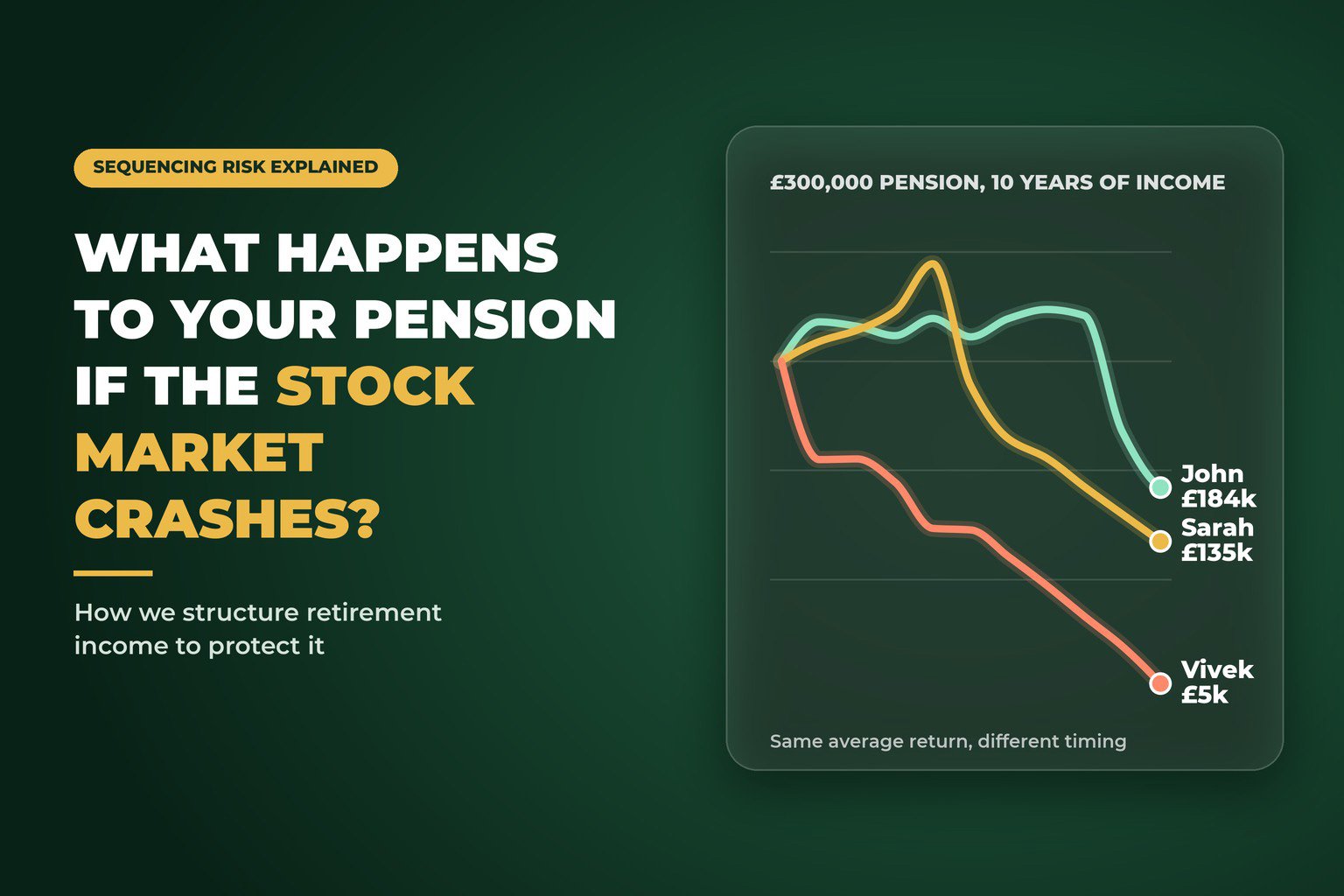

How We Structure Retirement Income to Protect It
We’ve all heard the line, “Investments can go up as well as down,” but even if you know this is true and you understand that markets can recover given enough time, it still doesn’t make it any easier when you receive a statement from your pension company or check your accounts online, and the value is constantly fluctuating.
In recent years, not only have we seen significant fluctuations in the stock market, but also in what are deemed safer assets, such as bonds. If you’re planning on retiring in the next few months or years and you know you’ll be relying on your pension and investments for income, then these ups, downs and general uncertainty can be extremely worrying. Even if you’re many years from taking any income from your pension or investments, this might happen to you in the future.
In this blog, we’re going to explain what happens to your pension if the stock market crashes when you’re taking an income, how we help our clients reduce this worry when they reach retirement and how we structure their underlying investments to reduce this risk.
Why withdrawing during a market downturn has a bigger impact than you might think
Firstly, let’s get a better understanding of why making withdrawals from your pension when it has dropped in value or during a market downturn can have a bigger impact than you might think.
For this, we have an illustrative example. We have three people who have just approached retirement: John, Sarah and Vivek. All three retirees have a pension pot of £300,000. Over a 10 year period they all average a growth rate of 7% but where they see positive and negative growth differs.
| Year | 1 | 2 | 3 | 4 | 5 | 6 | 7 | 8 | 9 | 10 |
| John | 22% | 8% | 7% | 15% | 5% | 16% | 13% | 9% | −20% | −5% |
| Sarah | 16% | 13% | 15% | 22% | −20% | −5% | 8% | 5% | 7% | 9% |
| Vivek | −20% | 15% | 5% | −5% | 22% | 7% | 8% | 9% | 16% | 13% |
John’s pension has a great start, growing 22% in the first year. In the following seven years, John’s pension sees positive growth each year. However, in the last two years, John’s pension fund experiences negative growth, falling by 20% in year 9 and 5% in year 10.
Sarah’s pension also sees positive growth in the first few years; however, the pension has negative growth in the middle of her 10 years at years 5 and 6. After this, the fund performance picks back up over the final four years.
Finally, Vivek’s pension has a poor start with a significant drop in the first year, where the fund falls by 20%. The second and third years are positive; however, the fourth year sees the fund fall by 5%. Thereafter, the remaining years are all positive.
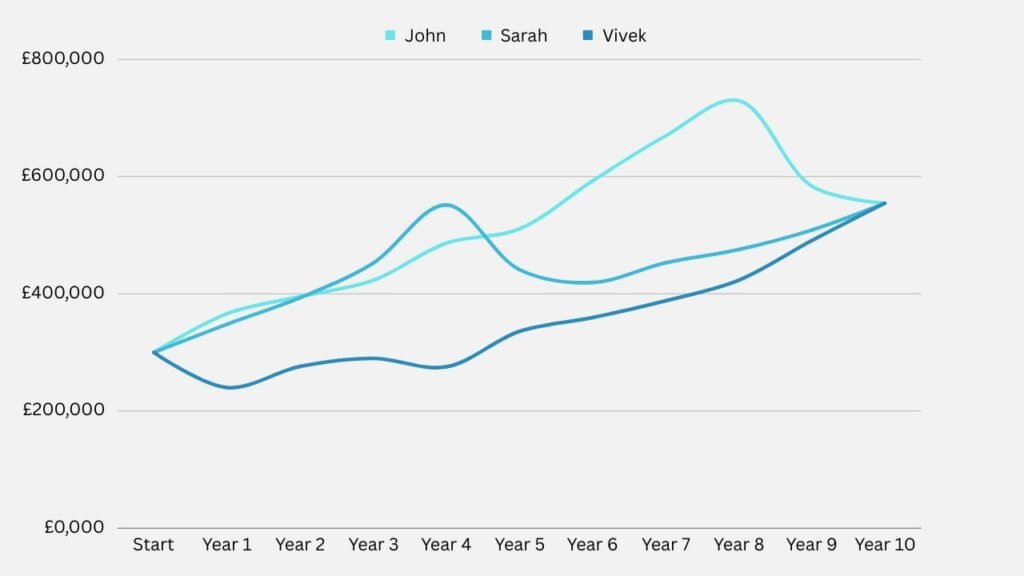
So, despite each person’s pension fund growing and falling at different times, over these 10 years the average growth rate for all three pension funds is 7% therefore they all end up at the same value of just over £550,000.
What happens when they start taking an income?
However, in our example, John, Sarah and Vivek have just retired. They’re no longer working and need a source of income for the next 10 years before their State Pension and a final salary pension start. They each withdraw £30,000 a year from their pension through drawdown and increase this withdrawal by 3% each year to help maintain their purchasing power. Let’s have a look at the effect of this on each pension.
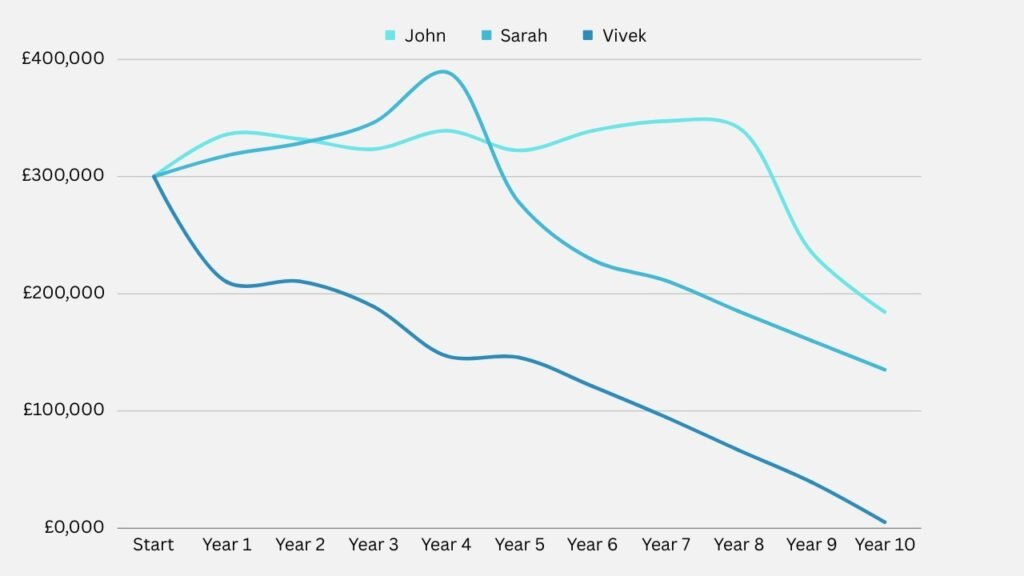
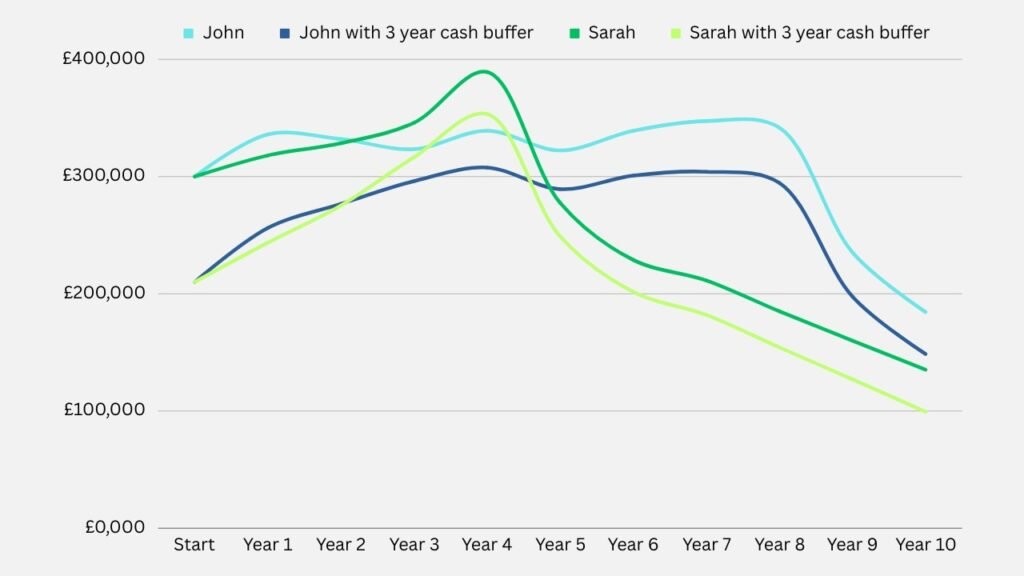
The difference in the pension values between John, Sarah and Vivek is huge. John’s pension after 10 years is worth over £184,000, Sarah’s is approximately £135,000, whereas Vivek’s is only just over £5,000. The difference in the final 10 year value between John and Vivek is over £179,000.
Why is there such a difference?
So why is there such a difference when their average rate of return was the same for all three? The reason for this is down to timing. When they had good years and when they had bad years during their 10 year stretch has a real impact on their final pension value.
In John’s case, he experienced higher than average returns early in his retirement. This initial positive growth increased the overall value of his pension and allowed John to take his income without depleting the principal value of his pension pot. The positive return not only boosted his pension value initially but also set him up for a greater compounding effect. As his pension grew in the first year, the returns generated in the following years became more significant as they were starting from a higher point. This provided John with a much needed cushion for the later years, where he experienced negative growth in years 9 and 10.
Sarah had a significant dip in the middle of her 10 years, which impacted the portfolio value, but the damage was lessened due to the positive growth she saw in years 1 to 4.
However, Vivek had a poor start in the earlier years, and this is where we see a greater impact. Vivek started withdrawing money during a market downturn; therefore, he was required to sell his underlying pension fund at a lower price, locking in these losses. Even though Vivek’s pension did experience higher than average returns in the later years, at that point the pension value was already depleted, and therefore the impact of this growth was lessened as it was from a lower starting point.
What is sequencing risk?
This concept is known as sequence of returns risk, or sequencing risk. So how do we help our clients reduce this risk?
Holding a cash reserve
The first thing we look at is holding a portion of cash, either inside the pension or externally in a savings account or ISA, and using this cash reserve to fund the first 1 to even 4 years of retirement.
Let’s compare Vivek’s situation if he were to hold 3 years’ worth of income in a cash reserve. At the start of Vivek’s retirement, he switches £90,000 from his pension fund into cash within his pension, earning an interest rate of 3%, meaning he has £210,000 remaining invested in his pension fund. For the next 3 years, he does not withdraw from his pension fund and uses his cash reserve instead. This means he does not lock in the earlier losses he experienced and therefore gives his pension fund additional years to recover before withdrawing from it.
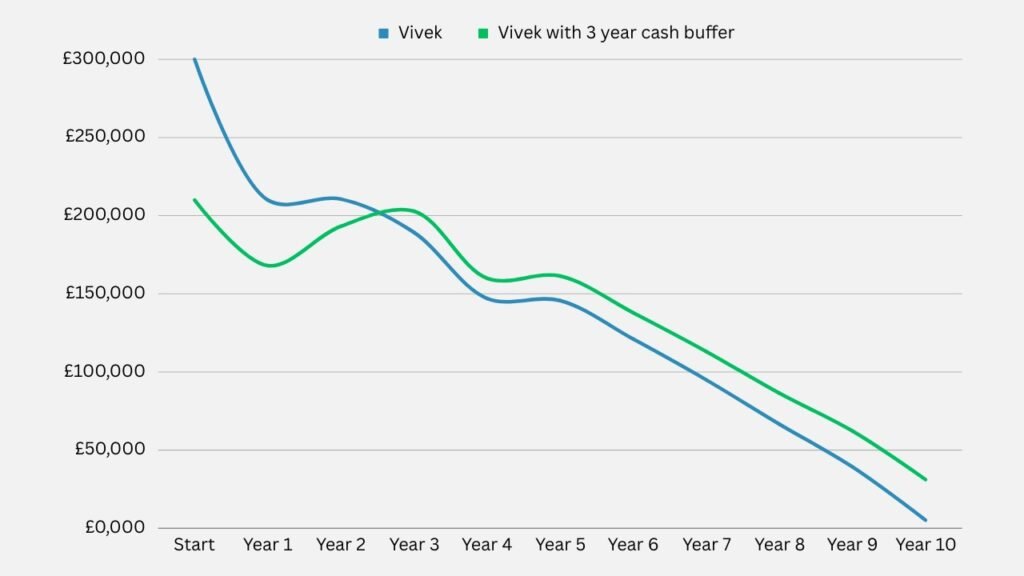
The result of this is that after 10 years, the pension value is around £26,000 higher when using a 3 year cash reserve strategy compared to putting 100% in the pension fund.
While cash and savings accounts do not fluctuate like a typical pension fund would, there is the consideration that cash holdings may not keep up with inflation, and therefore the real value of this money diminishes.
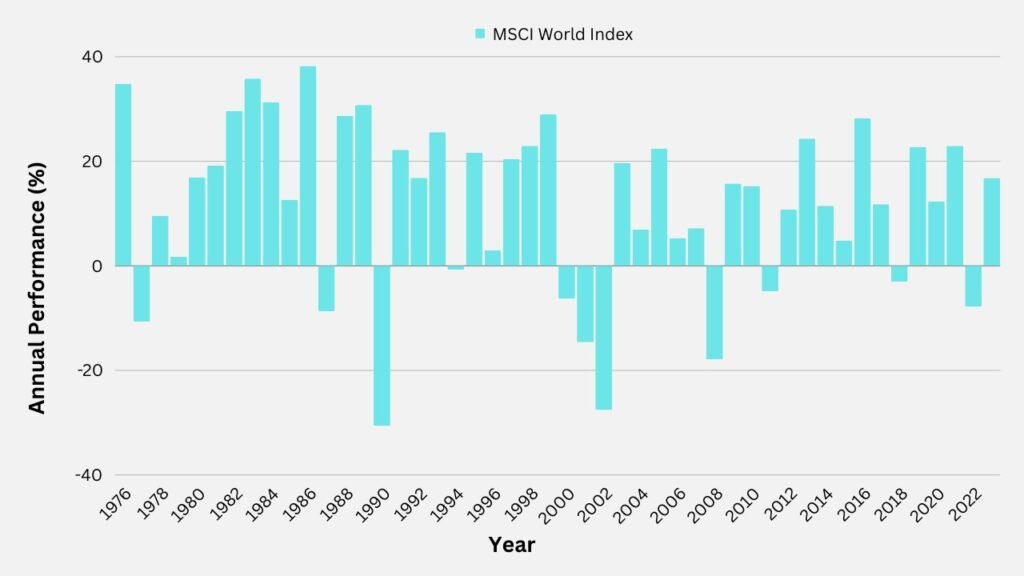
Also, a well diversified and suitably invested pension fund does have greater odds of going up in value than not. Data from the MSCI World Index, which is a benchmark that measures the performance of solely equity markets across developed countries, has shown that between 1976 and 2023, the index had positive growth in 37 of those 48 years, which is 77% of them.
So, in the case of Sarah and John, they saw positive returns early on and therefore would’ve missed out on these initial years of growth. If Sarah and John also adopted this 3 year cash reserve strategy, it would have resulted in their pension values being roughly £36,000 lower than if they had stayed 100% in the original pension fund.
The bucket approach
But we can go one step further. Instead of just having a cash reserve and a pension fund, we can segregate a client’s income into three, four or even five different pots for different income periods. This strategy is commonly known as the bucket approach. With a bucket approach, not only would a client have their cash reserve for their short term income and their pension fund for their long term income, but we introduce at least one other bucket for a period between these two.
Here’s an example of this approach using three buckets. In bucket 1, again we would hold cash, but as we’re adopting a three bucket approach, we will have 1 to 2 years’ worth of income in here. The second bucket will hold assets that are typically less volatile than our third bucket and therefore likely include a portion of bonds, but will also be exposed to equities, giving the prospect of additional growth. This bucket will have income from years 3 to 7. Our final bucket, for year 8 onwards, will be the most growth orientated, so the majority of the underlying investments will be in equities. The goal here is to let these investments grow over time whilst we use the first two buckets for the earlier years of income. Although this bucket is likely to be the most volatile, we have more time on our side, giving us a greater chance of higher growth during these 7 years prior to taking income from it.
When we use this strategy, we revisit the initial set up and adjust the allocation of money in each bucket where needed. We look at this at least annually with our clients to make sure it is still suitable for them.
Getting the balance right
So, of course, there is a balance to strike here and different risks to consider on how a portfolio is set up when income starts to be drawn from it. Having a cash reserve pot reduces the impact of sequence of returns risk and can give a pension the time required to recover if it does fall in value in those initial years. However, allocating too much to cash or bonds in a pension can cause a drag on the overall long term growth, and this could mean the pension grows at an insufficient rate to meet a client’s retirement income needs.
No one can be certain of what the future growth rates will be of anyone’s pension fund, whether it be this year, next year or any years after that, so we build and stress-test a plan that is personal to each client and what brings them peace of mind. Factors such as whether their withdrawals are sustainable, whether their overall pot is sufficient to withstand significant short term falls, how they feel about the ups and downs in their portfolio, whether they have any other income sources they can rely on, or whether they have the flexibility to reduce their income all come into play when deciding what is an appropriate level of cash, bonds, equities and any other assets in their portfolio.
How we help clients with retirement planning
When we work with clients who are approaching retirement, we go through each of these factors with them.
We then use cashflow modelling to show how their pension would hold up if markets fell in the first few years of their retirement. From there, we decide how much to hold in cash, bonds and equities, and whether a cash reserve or bucket approach suits them.
Once it’s set up, we review it with them at least once a year, so the cash reserve or buckets can be adjusted as things change.
If you’d like to see how this would look for your own pension, you can find out more about our retirement planning service or get in touch.
This is general information only and shouldn’t be taken as personal financial advice. How you structure your retirement income is heavily influenced by your individual situation, tax position and long term goals, so if you’re considering changes, it’s worth doing your own research or speaking to an independent financial adviser. The example in this post uses hypothetical returns for illustration only. Past performance is not a reliable indicator of future returns.