

This guide covers how workplace pensions work in practice: how tax relief benefits you, where your money is invested, and what your options are when you come to take it out.
What is a defined contribution pension?
A defined contribution (DC) pension is a pot of money that builds up over time from contributions and investment growth. There’s no guaranteed income — what you end up with depends on how much has gone in and how it’s performed.
This differs from a defined benefit (DB) pension, more common in the public sector or in older schemes, which promises a guaranteed income in retirement instead of a pot. In this guide, I’ll be focusing on a defined contribution pension.
You can currently access a defined contribution pension from age 55. This is rising to 57 from 2028.
The amount you end up with comes down to four factors:
- How much you’re contributing
- How much your employer is contributing
- How your investments are performing
- The charges applied to the pension
How tax relief works on a workplace pension
Workplace pensions receive tax relief in different ways depending on how the scheme is set up. Here’s how the three main methods compare.
Salary sacrifice
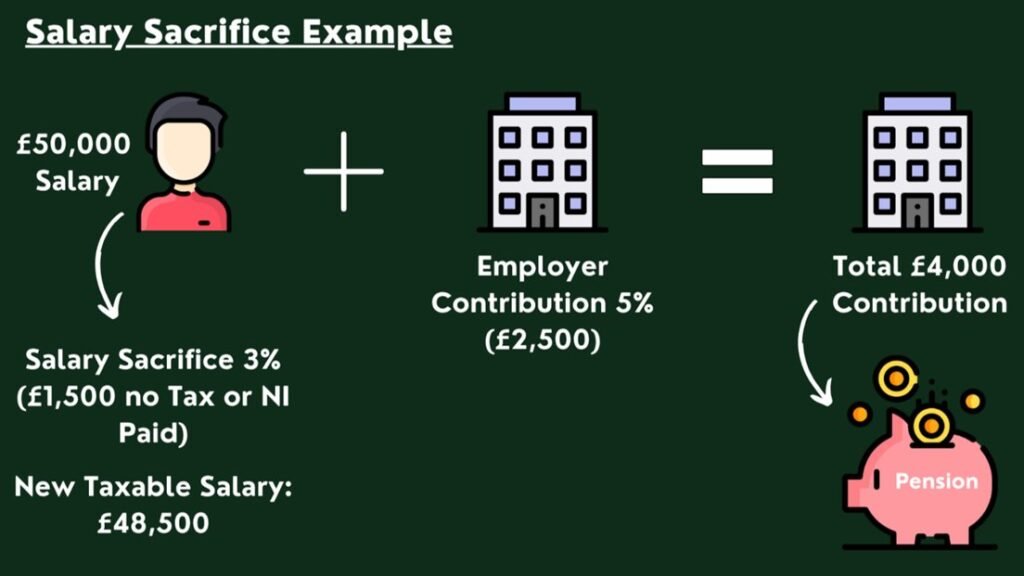
Salary sacrifice is generally the most tax-efficient method available. You give up part of your salary, and your employer pays that amount directly into your pension before income tax and, critically, National Insurance are applied. Rather than being paid the money and then choosing what to do with it, it’s redirected straight into your pension automatically.
For example: someone earning £50,000 who sacrifices 3% of salary (£1,500) reduces their taxable salary accordingly. They pay less income tax and less National Insurance. Their employer also contributes on top — and because the employer saves National Insurance too, some schemes pass part or all of that saving back into the pension, or use it toward other employee benefits.
From April 2029, the rules around salary sacrifice for pensions are due to change. Under the current proposal, the first £2,000 sacrificed each year will remain exempt from National Insurance, but amounts above that will likely be treated more like normal earnings — meaning both employee and employer National Insurance would apply. Income tax relief itself isn’t affected.
Net pay
A net pay arrangement is similar to Salary Sacrifice but your contribution is taken from salary before income tax, but after National Insurance. You still get full income tax relief, including higher rate relief if you’re entitled to it, but there’s no National Insurance saving.
Relief at source
A smaller number of workplace pensions, along with personal pensions like a SIPP, use relief at source. You contribute after tax, and the provider adds basic rate tax relief on top — so an £80 contribution becomes £100 in your pension. Higher and additional rate taxpayers can usually claim the extra relief back from HMRC.
The end result can be broadly similar across all three methods, but salary sacrifice and net pay are simpler because relief happens automatically, whereas relief at source requires higher rate taxpayers or above to actively claim what they’re owed.
Contribution Limits
For the 2026/27 tax year, the annual allowance is £60,000 or 100% of your earnings if lower. This includes both personal and employer contributions.
If you haven’t used your full allowance in the previous three tax years, carry forward may let you contribute more than £60,000 in the current year and still receive tax relief.
Some people may have a lower annual allowance due to additional pension rules. The tapered annual allowance affects high earners and can reduce the £60,000 limit if your income exceeds certain thresholds. The Money Purchase Annual Allowance (MPAA) applies if you’ve already taken taxable income from a defined contribution pension, such as through drawdown, and this reduces how much you can contribute to pensions with tax relief going forward.
These rules can significantly limit future pension contributions, so it’s important to understand whether they apply to you.
Employer Matching
Many employers also match contributions above the minimum. Increasing what you put in can unlock extra employer money — effectively free money going into your pension, and one of the simplest ways to boost retirement savings.
Where is your pension actually invested?
Pension money doesn’t sit in a bank account. It’s invested, with the majority typically into three asset types:
- Equities (shares in companies)
- Bonds (loans to governments or companies that pay interest)
- Property (often commercial buildings or infrastructure)
A smaller portion may also be invested in other asset types, such as commodities, alternatives, or cash.
Rather than buying these directly, your pension invests via a fund. A pension fund pools your money with thousands of other savers, and a professional fund manager decides how it’s invested. The number of fund choices varies by provider — larger providers like Aviva or Standard Life typically offer hundreds of funds, while more basic schemes like Nest or the People’s Pension usually offer a handful.
If you don’t actively choose where your pension is invested, you’ll typically be placed in the default fund.
How the default fund works
The default fund usually follows a lifestyle strategy: when you’re younger and further from retirement, your money sits mostly in growth assets like equities. As you approach retirement, the fund gradually shifts into less volatile assets like bonds, and sometimes cash — reducing day-to-day swings as you near the point you might start withdrawing.
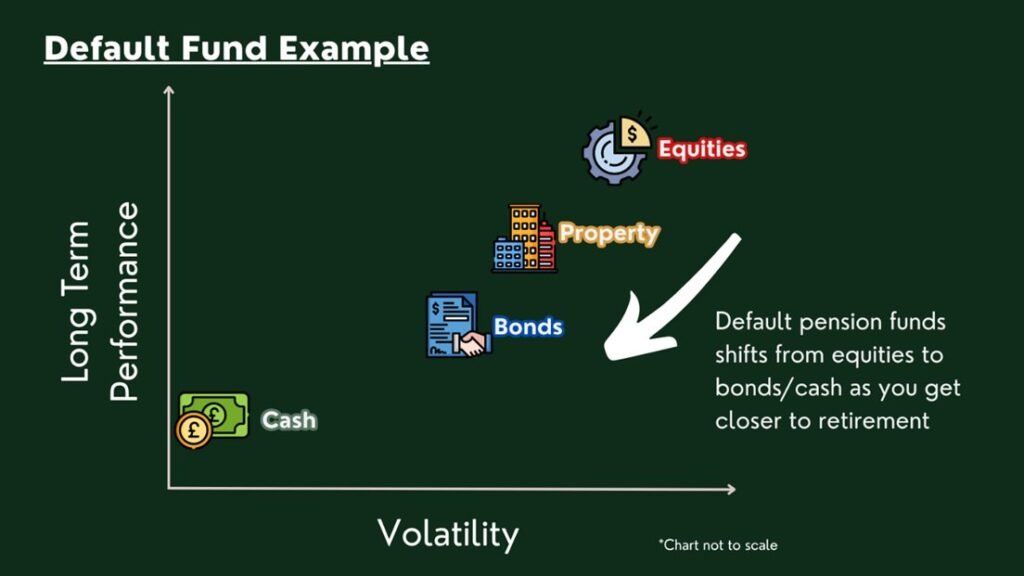
Broadly, equities fluctuate more day to day but have historically delivered stronger long-term growth. Bonds are generally steadier but tend to grow more slowly. Cash is the most stable but often struggles to keep pace with inflation.
The default strategy divides opinion. Some argue it de-risks people too early — if your retirement is likely to last 30–35 years, being invested too cautiously from your mid-50s onward may not generate enough growth to sustain it. Others argue the default works reasonably well for someone who doesn’t want to actively manage their pension. There’s no single right answer for everyone, which is why it’s worth understanding what your default strategy actually looks like and whether it fits your own retirement plans.
Why investment choice matters — a worked example
To illustrate the difference in investment funds have on your pension, we have used cash flow modelling software that uses historical market and inflation data as a basis, and projects it forward.
Sam is 30, earns £35,000 a year, and contributes 5% of salary into his pension, with his employer adding another 3% — £2,800 a year in total, rising with inflation. The only thing that changes between two scenarios is how his pension is invested:
- 60% equities / 40% bonds: projected median pot of around £226,000 with a likely range between £183,900–£222,300 (based on 70% of modelled scenarios)
- 90% equities / 10% bonds: projected median pot of around £273,000 with a likely range between £225,200–£330,500 (based on 70% of modelled scenarios)
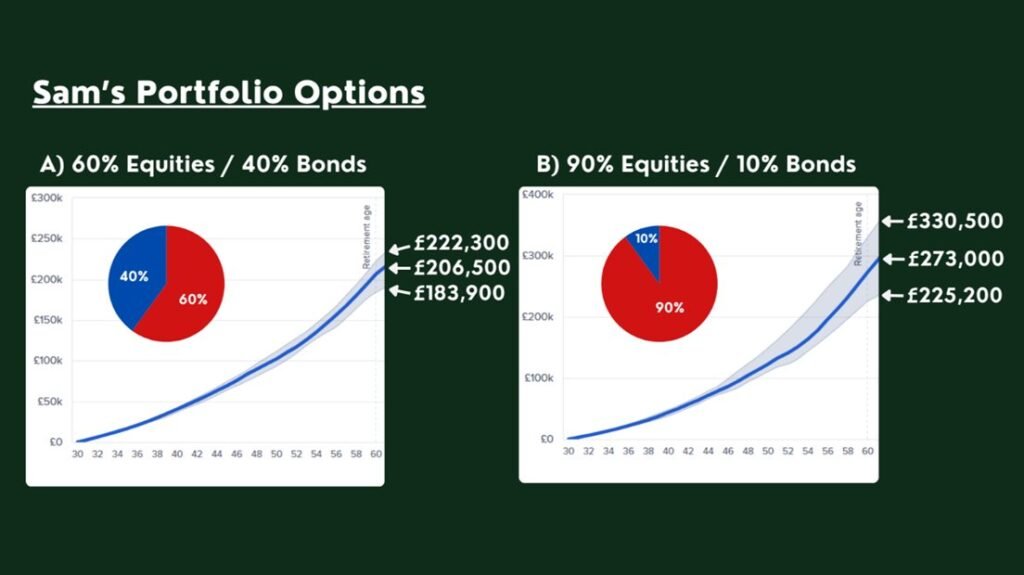
The more equity-heavy portfolio carries a wider range of outcomes, but a materially higher projected value — a difference of tens of thousands of pounds purely from how Sam’s pension is invested, not from saving more or saving for longer. Over long time periods, especially when you’re younger, the level of equity exposure can have a significant impact on the eventual size of your pension.
This is not a prediction or a guarantee, and of course performance in terms of future returns and actual outcomes will vary. The point of the example is to illustrate the difference investment choice can make, not to forecast exactly what Sam will end up with.
Why contribution size and time matter
Contribution levels and how long you contribute are a big factor. Below we have three different monthly contribution levels over three different time frames, assuming a real return of 4.2% a year (above inflation and fees):
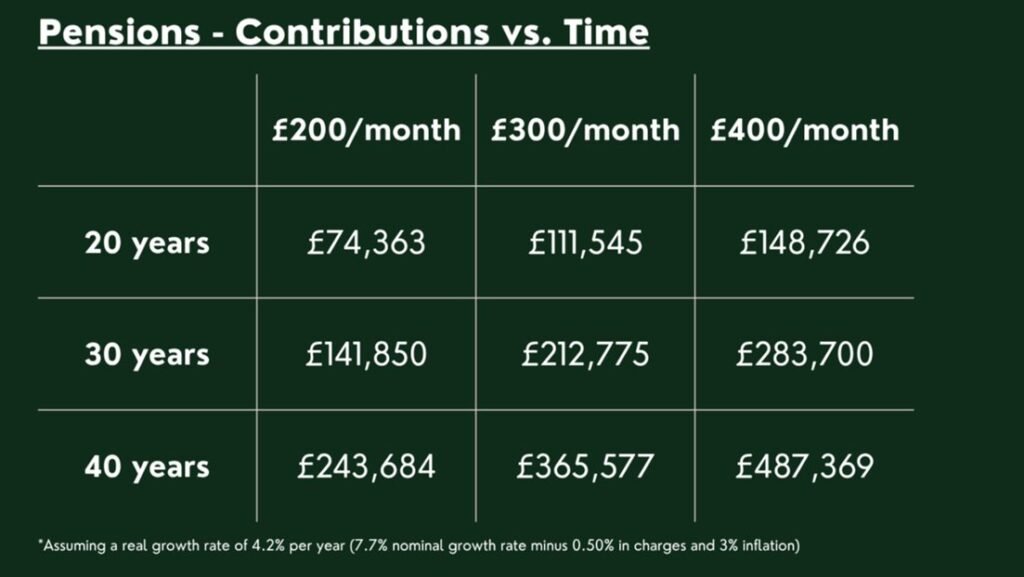
A £100-a-month difference doesn’t sound significant, but compounded over decades it can add up to a large difference in the final pot. This is why reviewing your contribution level as your income grows matters — small increases, especially when matched by an employer, can mean tens of thousands of pounds more at retirement.
It’s also worth understanding how much of a pension actually comes from growth rather than contributions. In a £300-a-month, 40-year example, total contributions come to £144,000 — but the projected final pension value is over £365,000. Well over half the final pot comes from investment growth, not the money physically paid in.
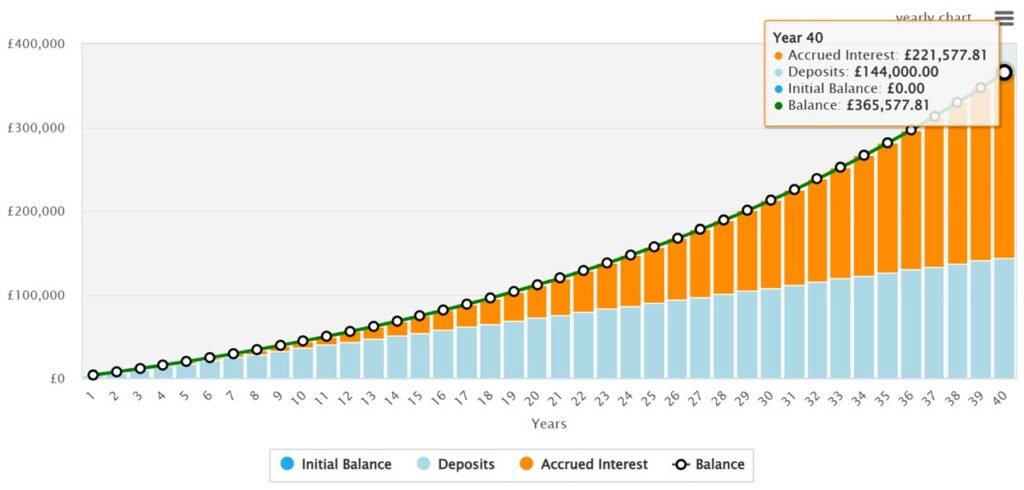
Early on, growth looks slow and most of the value comes from contributions. Over time, growth starts generating its own return and the effect snowballs. This is also why stopping and starting contributions, or opting out for long periods, can be so damaging — it interrupts that compounding effect. Pensions reward patience and consistency more than getting every detail perfect from day one.
What to do if you have multiple pensions
Most people build up several pensions across different jobs. In many cases these can be transferred to a single provider, and consolidating often makes practical sense — making it easier to track your pensions, understand how they’re invested and manage your retirement planning. If you’re considering bringing your pensions together, our Pension Consolidation & Withdrawal Advice service explains the benefits, the risks and the key factors to consider before making any decisions.
That said, it’s not something to do automatically. Before transferring, check:
- Fees on the pensions you’re moving from and to
- Investment options available
- Income flexibility, whether the new provider gives you the withdrawal options you’ll want at retirement
- Guarantees or enhanced benefits, this is the most important check, particularly on older pensions. Some schemes offer guaranteed income levels or enhanced tax-free cash. If you transfer an older pension that has one of these benefits to a new provider, that benefit can be lost on the transfer.
Taking money out of your pension
Under current rules, in most cases 25% of your pension can be taken tax-free (unless you hold enhanced tax-free cash), with the remaining 75% taxed as income when withdrawn.
There are two main routes for taking an income:
- Annuity – Typically take your tax-free cash, then use the remainder to buy a guaranteed income for life.
- Drawdown -The more common and generally preferred option today. Your pension stays invested and you draw money as and when you need it — regular income, lump sums, or a mix. Drawdown offers flexibility, but requires planning.
Planning your drawdown
Once you move into drawdown, a pension shifts from being a savings product to an income source, and a few things become important in your retirement planning:
- How withdrawals fit with other income — state pension, rental income, part-time work, and the order and timing of what you draw down can materially affect how much tax you pay over the long term.
- Sustainability — being able to take as much as you want doesn’t mean you should. Many people are retired for 25–30 years, and taking too much too early can deplete a pension faster than expected. Some form of modelling or forward planning helps establish a realistic, sustainable withdrawal level rather than guessing.
- How you stay invested— leaving everything in bonds can limit long-term growth; being too equity-heavy generally increases volatility and this might not be right for you when you start to draw on a pension. This is relates to sequence of returns risk — a poor run of market returns early in retirement can impact how long a pension lasts, even if long-term average returns are fine.
Common workplace pension pitfalls
A few mistakes come up repeatedly, and they’re often the ones that quietly cost people the most over time:
- Not knowing where your pension is invested, or losing track of pensions from previous jobs altogether. Even a small change in investment mix can have a large long-term impact, as the Sam example above shows.
- Missing out on tax relief, particularly on relief-at-source pensions. Higher and additional rate taxpayers are entitled to more relief than is applied automatically, but have to claim it back via self-assessment or the government portal.
- Not maximising employer matching. Many employers increase what they contribute if you put in more yourself. Paying in only the minimum can mean leaving employer money on the table — worth checking with HR directly.
- Not having a plan at all. Pensions are often left until retirement is a few years away. The earlier you understand how yours works, the more control you have over the outcome.
With people’s retirement periods lengthening, relying on the state pension alone isn’t realistic for most people.
A workplace pension is likely to be one of the largest assets most people ever build, so understanding it, reviewing it periodically, and making informed decisions along the way can make a substantial difference to retirement income — or to how early you can afford to stop working.
FAQ
What happens to my workplace pension when I change jobs?
Your pension doesn’t move with you — it stays open with your previous employer’s provider, invested as it was, unless you choose to transfer or consolidate it. Any new job will typically set you up with a new workplace pension, which is how most people end up with several pensions over their working life.
What is a default fund, and should I stay in it?
The default fund is where your pension is automatically invested if you don’t make an active choice, usually following a lifestyle strategy that gradually shifts from equities into bonds as you approach retirement. For more information on the default fund, we’ve done a separate default fund blog
How much should I be paying into my pension?
There’s no single right figure — it depends on your income, retirement goals, and how long you have until retirement. Having some kind of plan or forecast can give you an idea of what your final pot will be when you come to retire. But the earlier you do this and the more you can increase your contributions, the bigger the impact, as the contribution and time example above shows.
This is general information only and shouldn’t be taken as personal financial advice. Pensions are heavily influenced by your individual situation, tax position, and long-term goals, so if you’re considering changes, it’s worth doing your own research or speaking to an independent financial adviser.